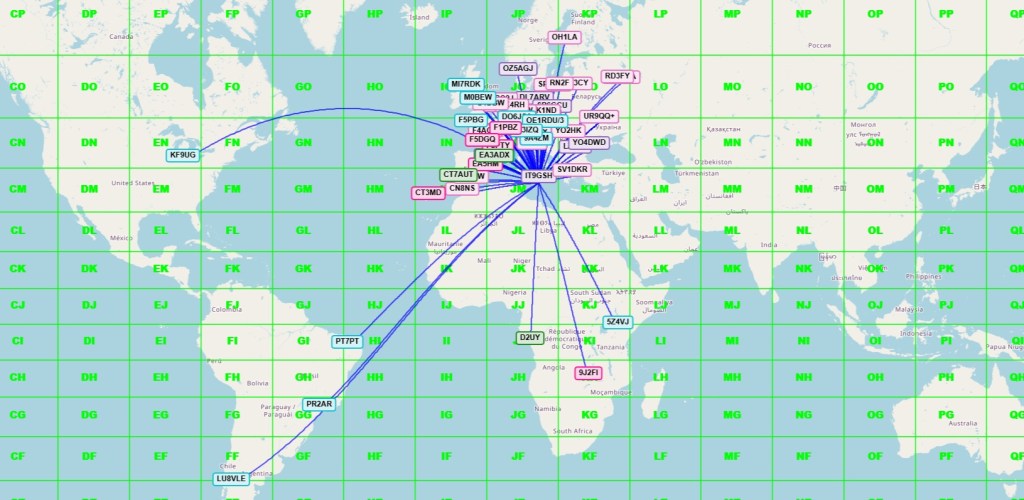
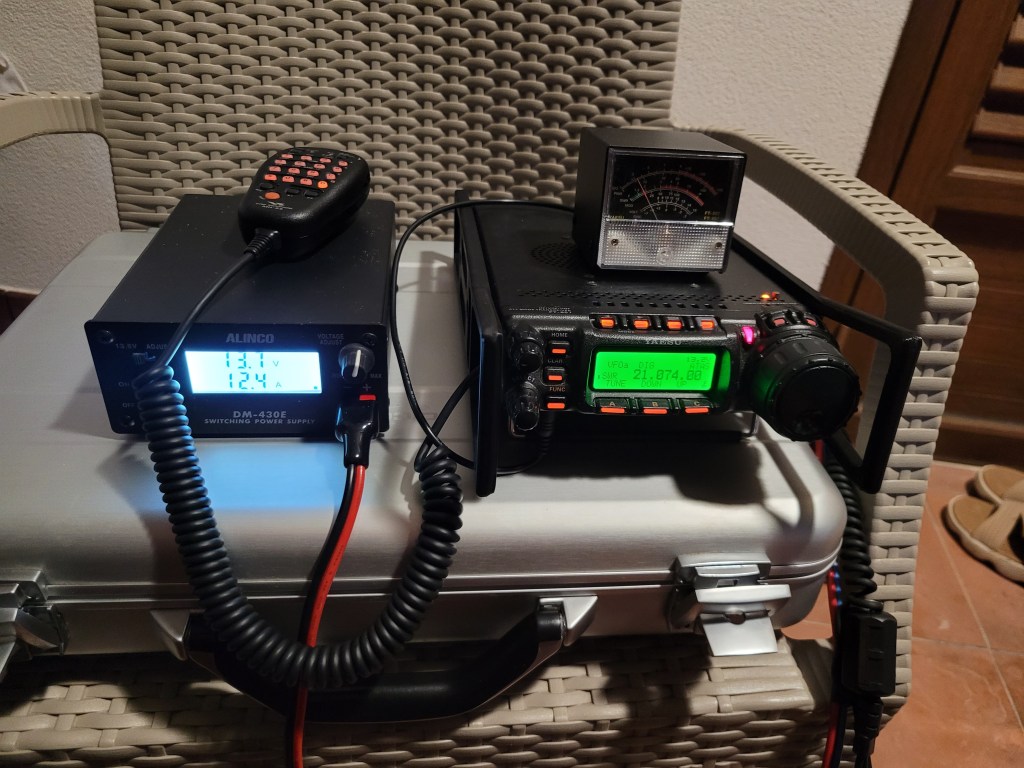
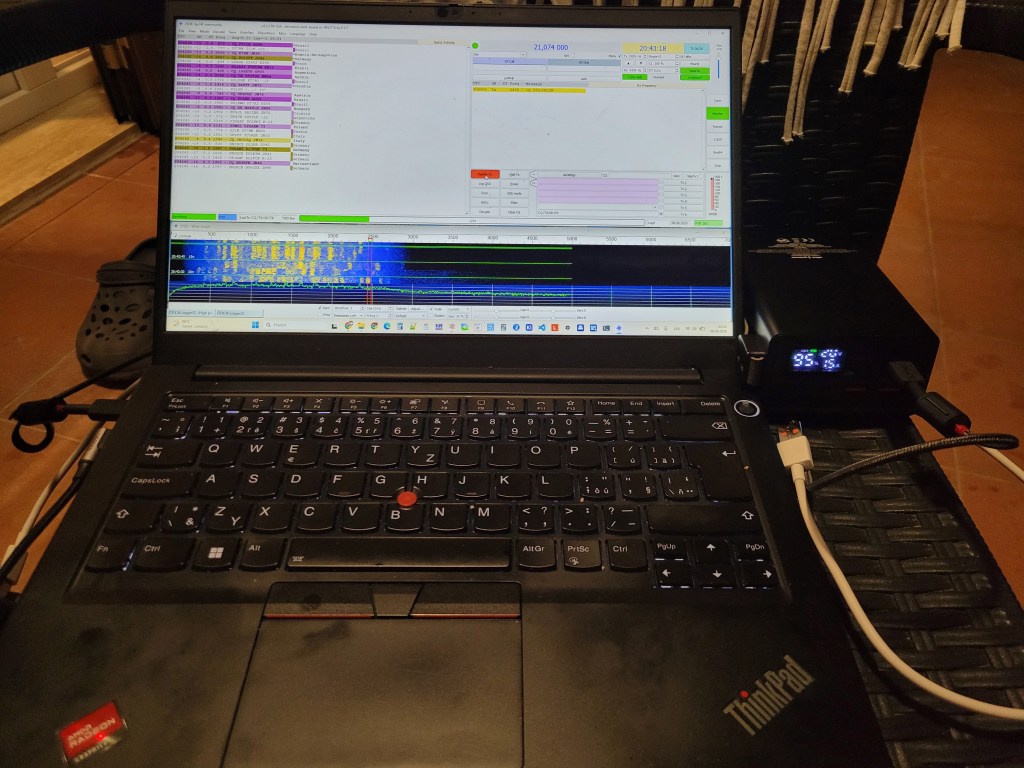
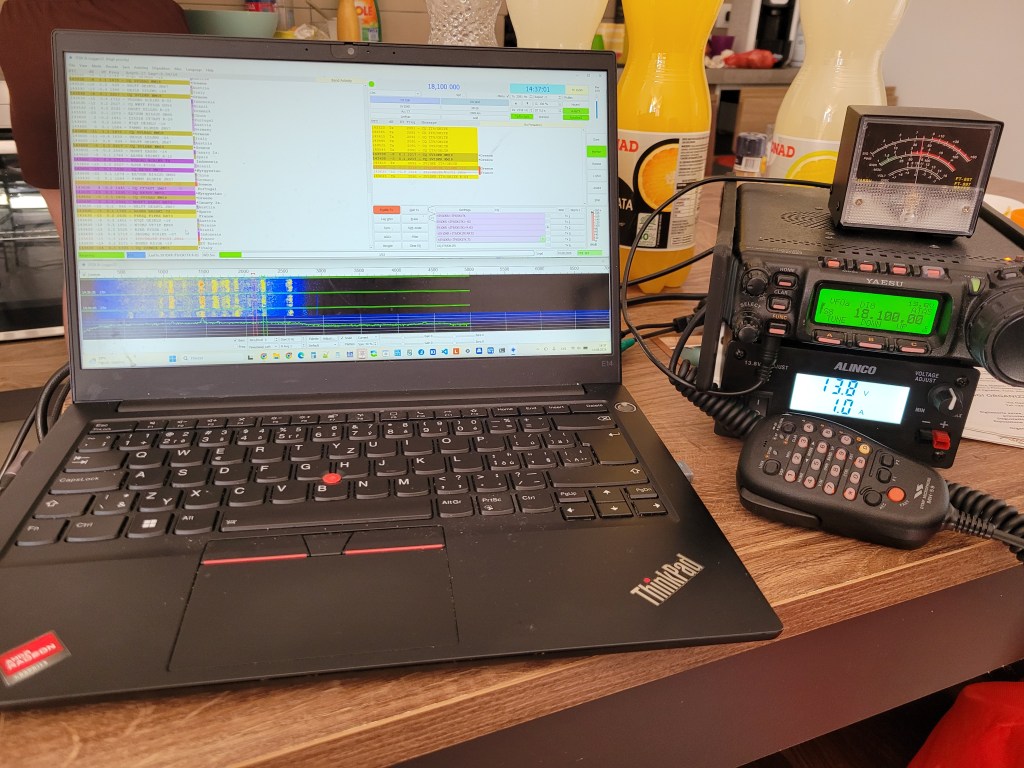
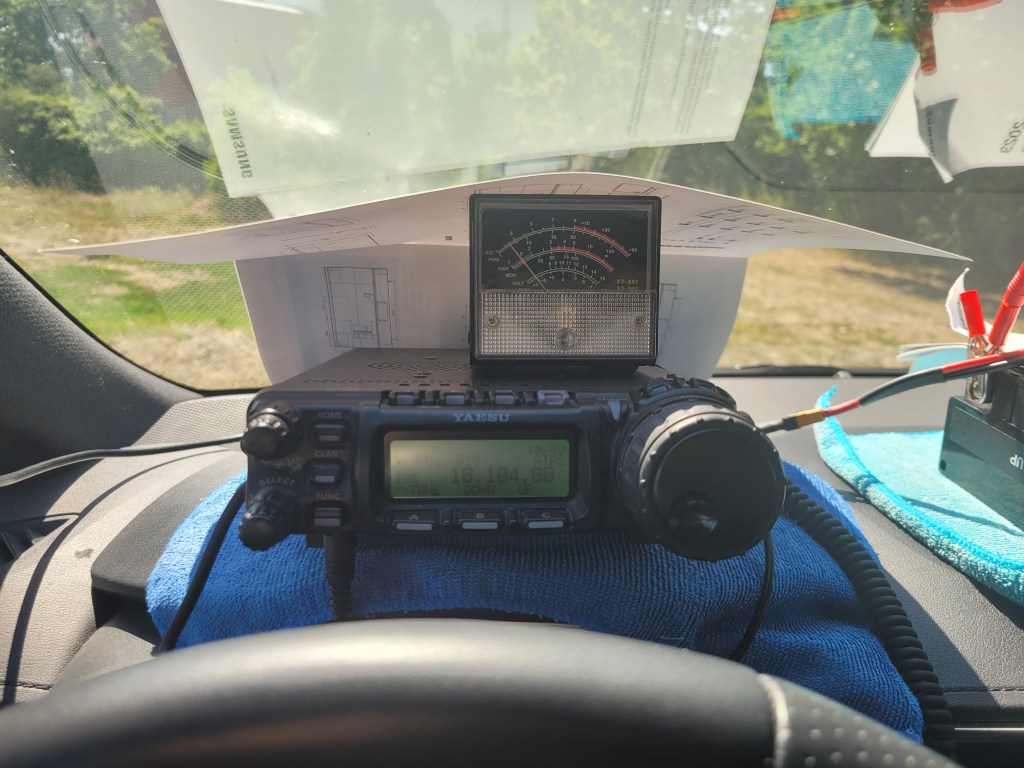
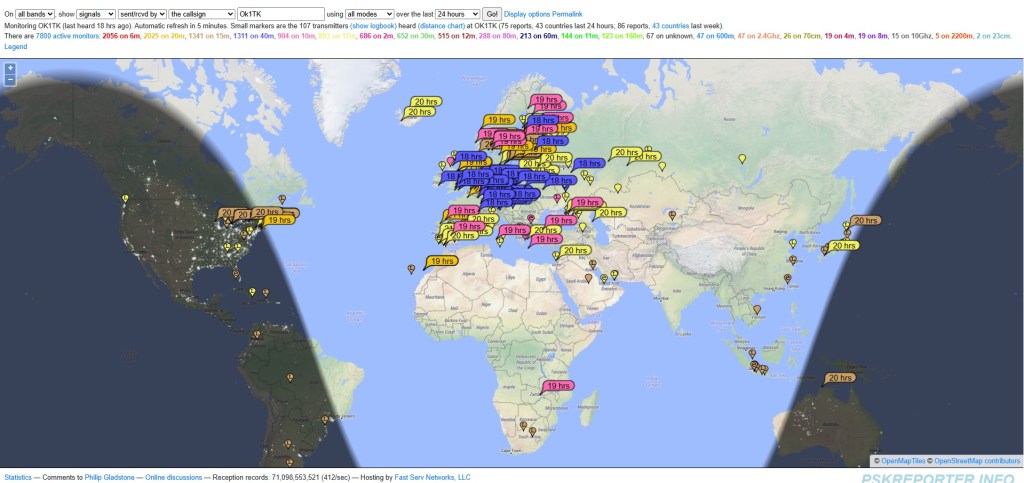
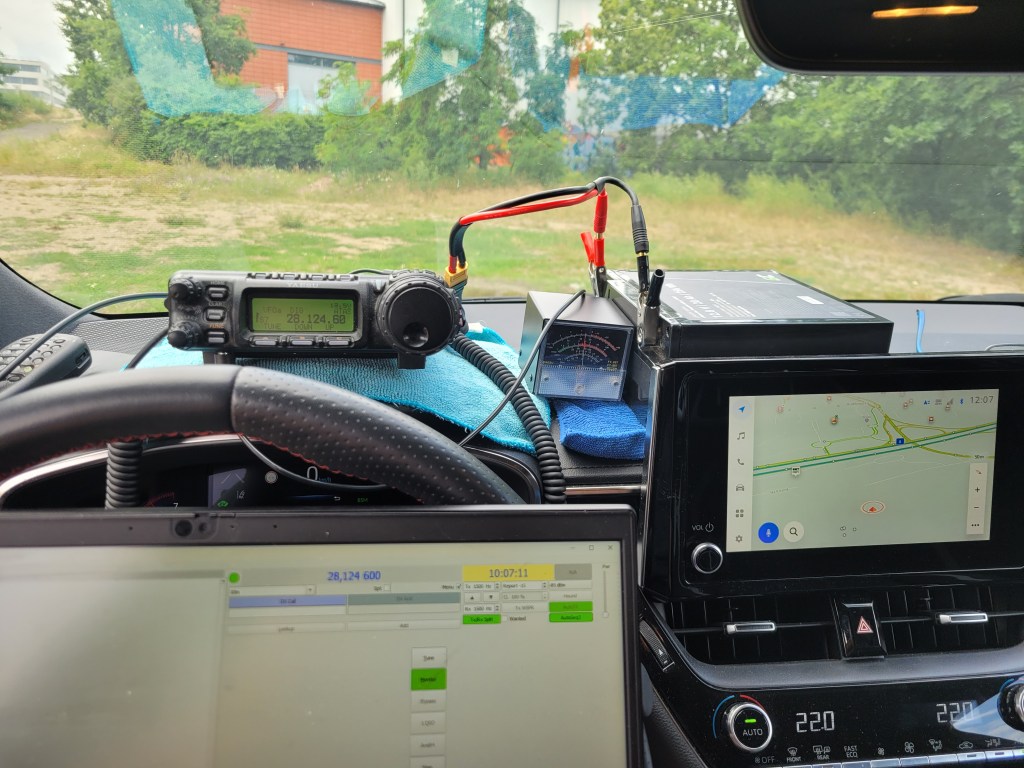
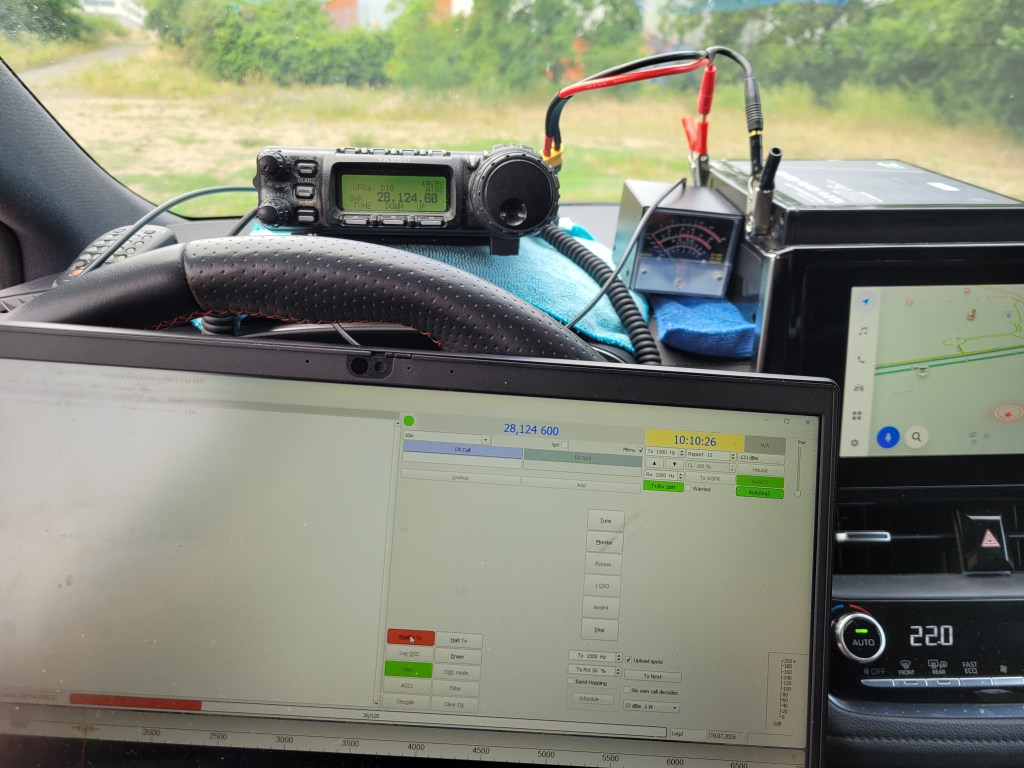
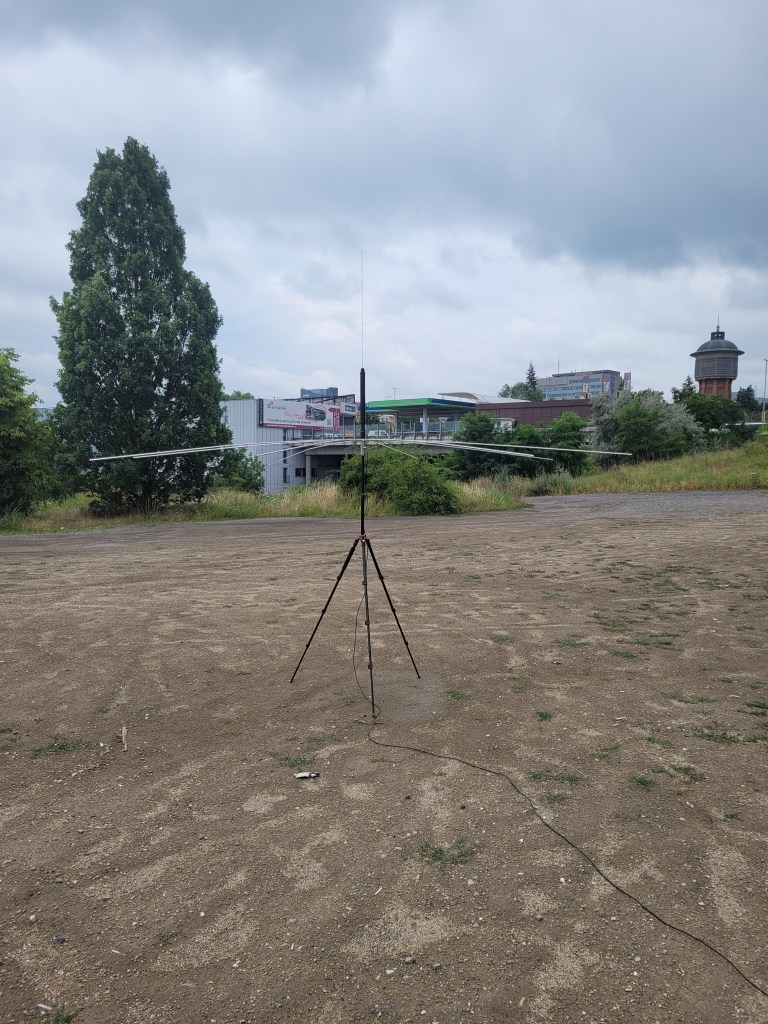
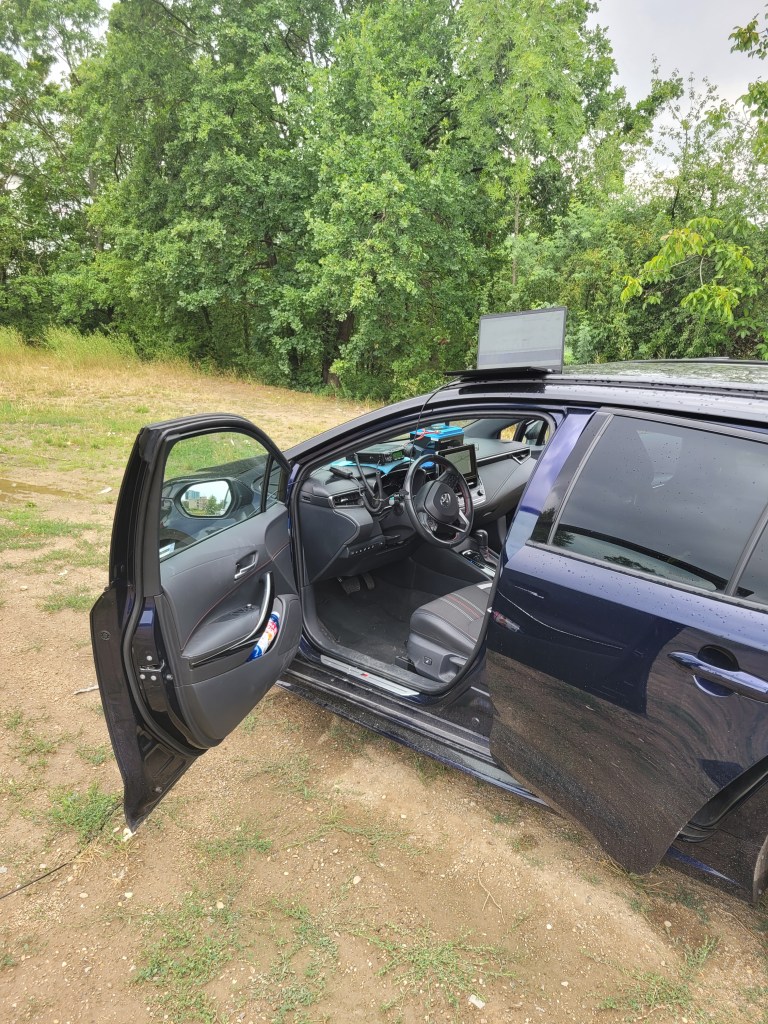
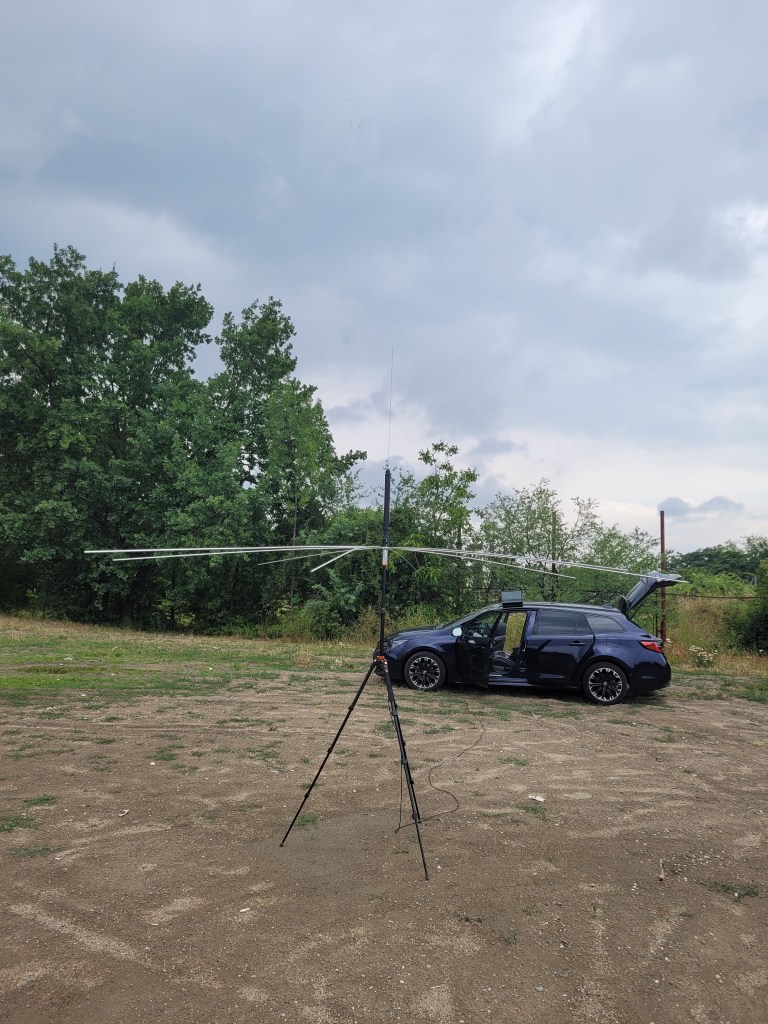
During the first operating sessions on 8 August and 10 August 2026, I spent only a few hours on the air using FT8 and FT4 from my holiday QTH in Caucana, Sicily (JM76GS).
I only managed to spend a few hours on the air during the first two operating sessions, but still logged 66 FT8/FT4 QSOs. A great start to the holiday operation, with contacts across Europe, Africa, North and South America. The longest QSO reached Argentina – over 12,000 km away.
Top 10 DX
Call
Country
Band
Mode
Distance
LU8VLE
Argentina
15 m
FT8
12,295 km
PR2AR
Brazil
15 m
FT8
9,289 km
PT7PT
Brazil
15 m
FT8
8,106 km
KF9UG
USA
15 m
FT8
8,100 km
9J2FI
Zambia
10 m
FT8
5,979 km
5Z4VJ
Kenya
15 m
FT8
4,813 km
D2UY
Angola
12 m
FT8
4,703 km
UA3VVA
Russia (Eur.)
17 m
FT8
2,950 km
CT3MD
Madeira Island
10 m
FT8
2,836 km
M0BEW
England
17 m
FT8
2,190 km
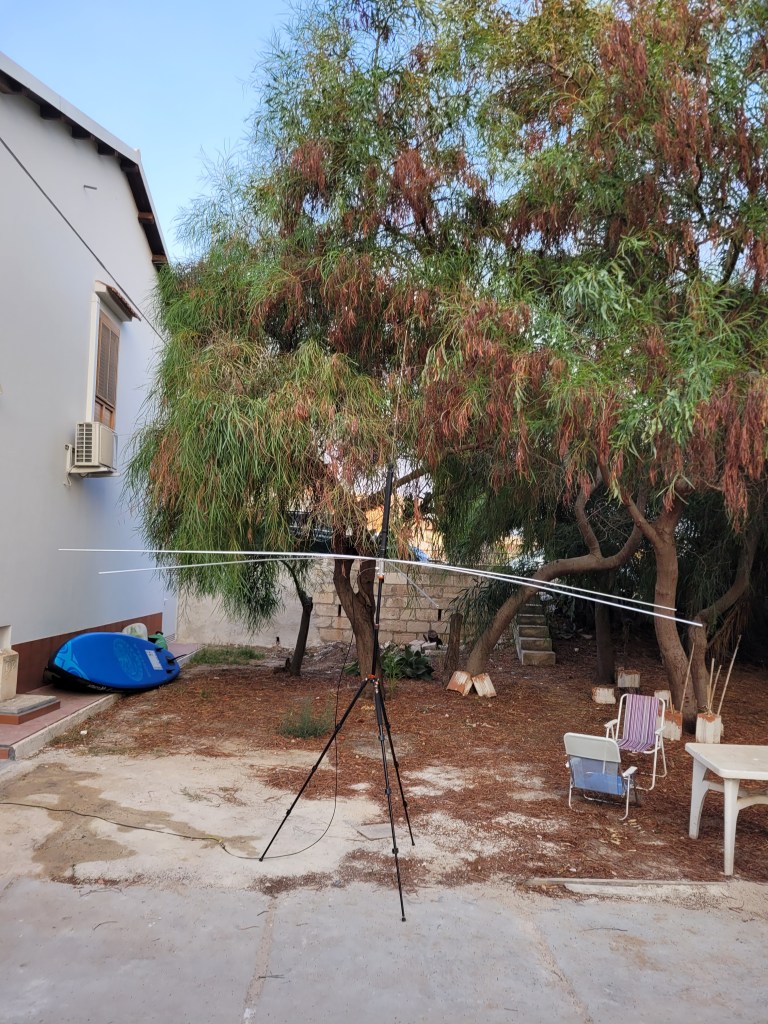
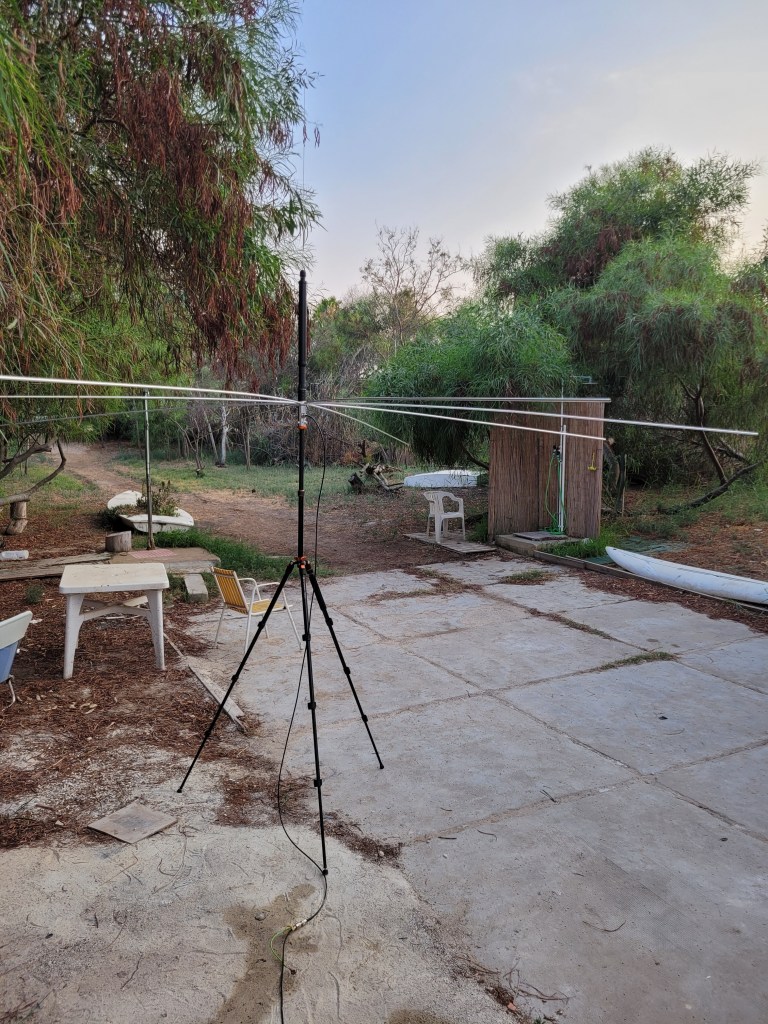
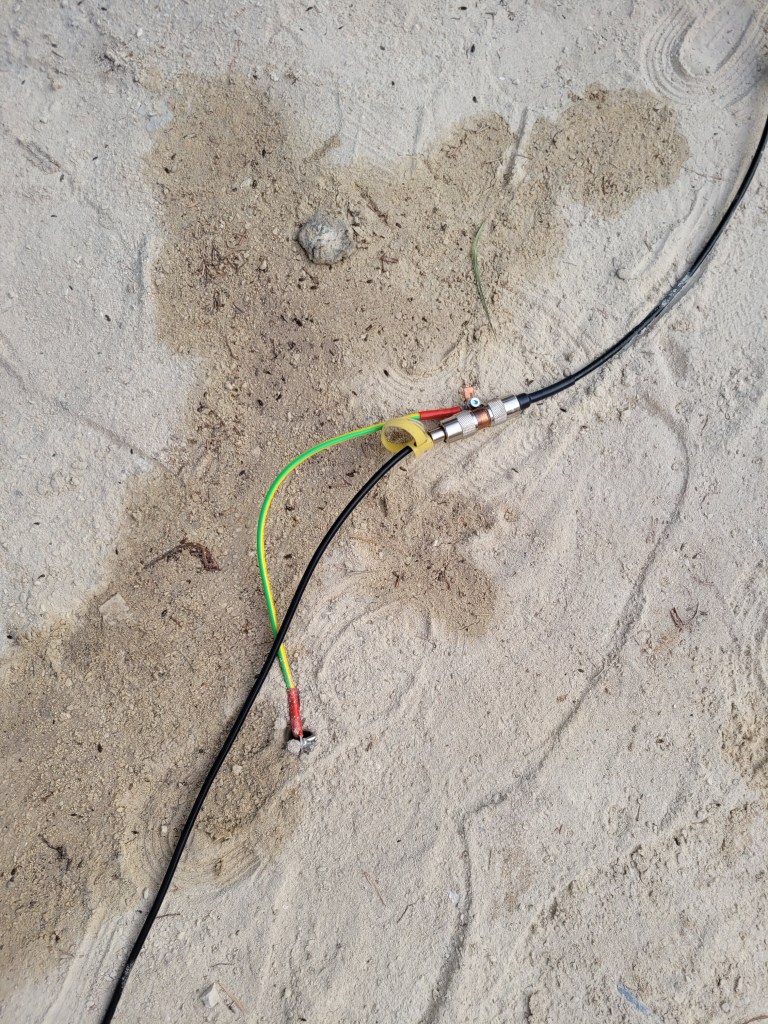
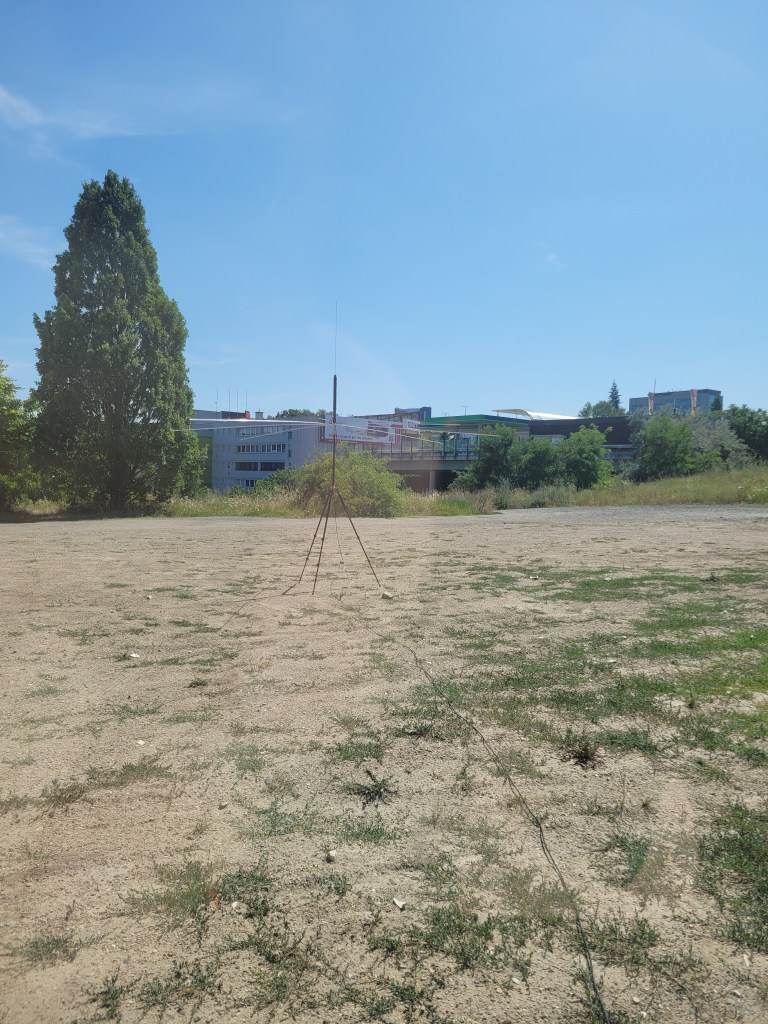
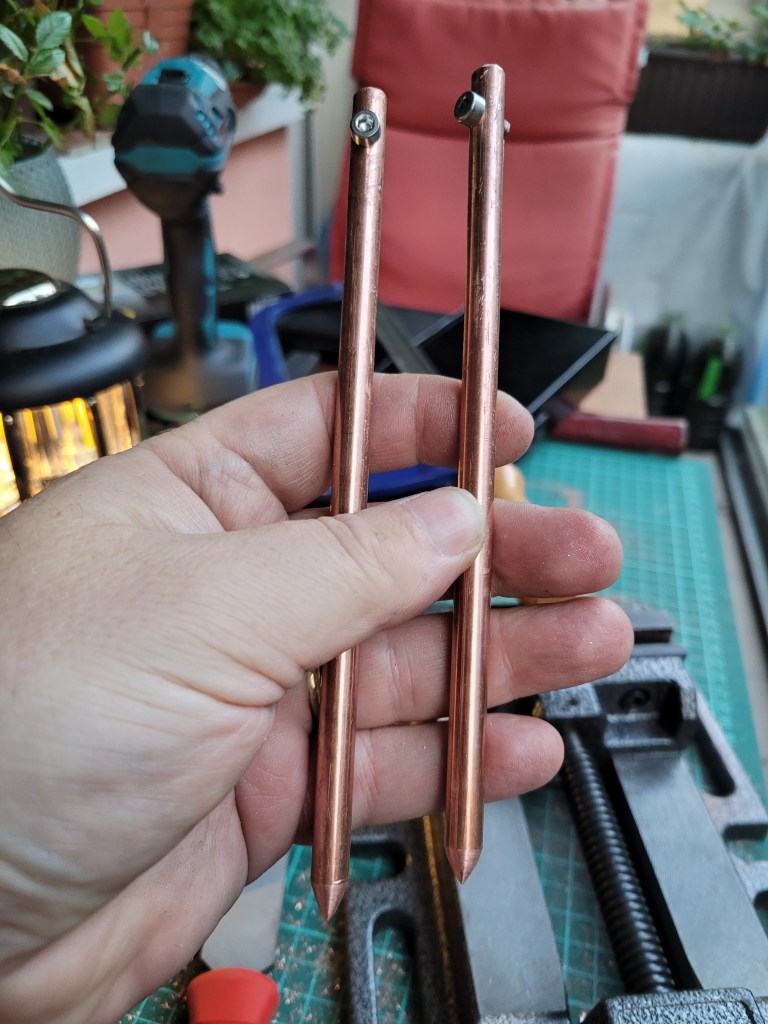
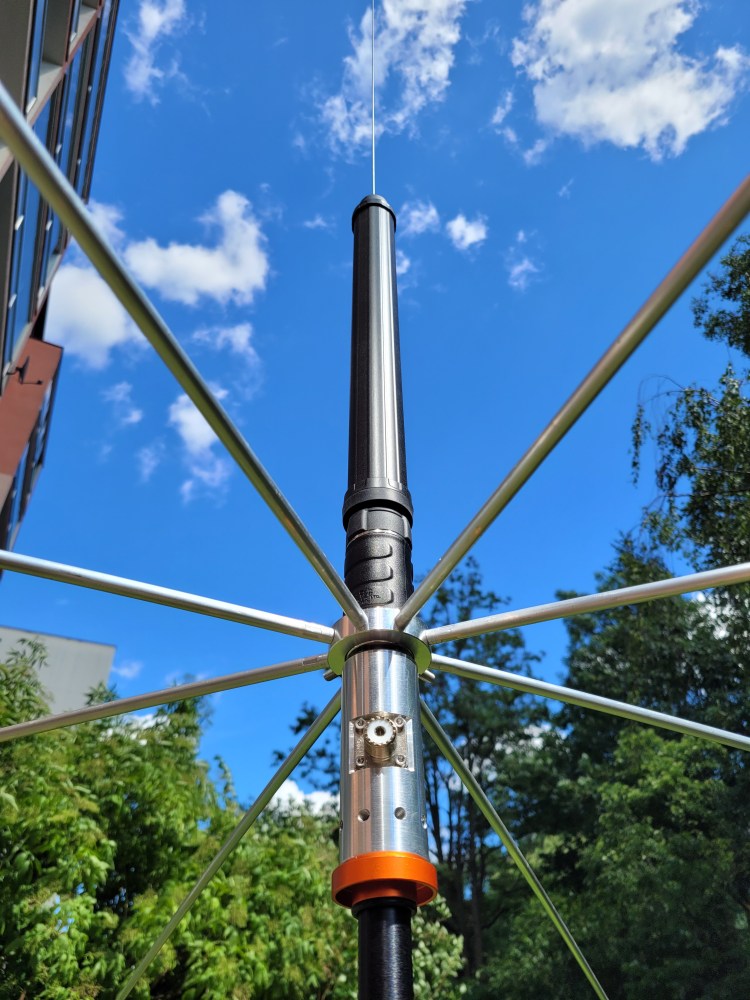
The portable station consisted of a Yaesu FT-857D and a Yaesu ATAS-120A mounted on a tripod approximately 2 metres above ground. The coaxial feedline was grounded at the antenna using a copper ground rod. On all bands from 20 m through 10 m, the ATAS tuned successfully, with SWR typically ranging between 1.0:1 and 1.5:1.
This WSPR test of the Yaesu ATAS-120A was carried out from the same location as the previous one, this time in hot and sunny weather. The goal was to check how repeatable the results were and to see how the current conditions affected the antenna’s performance.
The test started with the same setup as before, using only a single 10 m coaxial cable connected directly to the antenna. This served as the reference configuration for all further measurements.
Next, I inserted a 2.8 m coaxial cable using a UHF-to-UHF barrel connector. The connector was grounded using a homemade copper ground rod. After the connector, the original 10 m coaxial cable was connected back to the radio. In practice, I didn’t notice any measurable difference in the WSPR results or overall antenna performance.
Finally, I connected the Yaesu FT-857D chassis to a second copper ground rod using a 2 m grounding cable. This resulted in a small improvement in SWR. For example, on the 10 m band, the SWR dropped from about 1.3 to 1.1.
Overall, the SWR on the 20 m to 10 m bands remained between 1.0 and 1.5, so it wasn’t really a concern. Unfortunately, I couldn’t get the SWR below 2.5 on the 40 m band, as shown below.
10m (28 MHz)
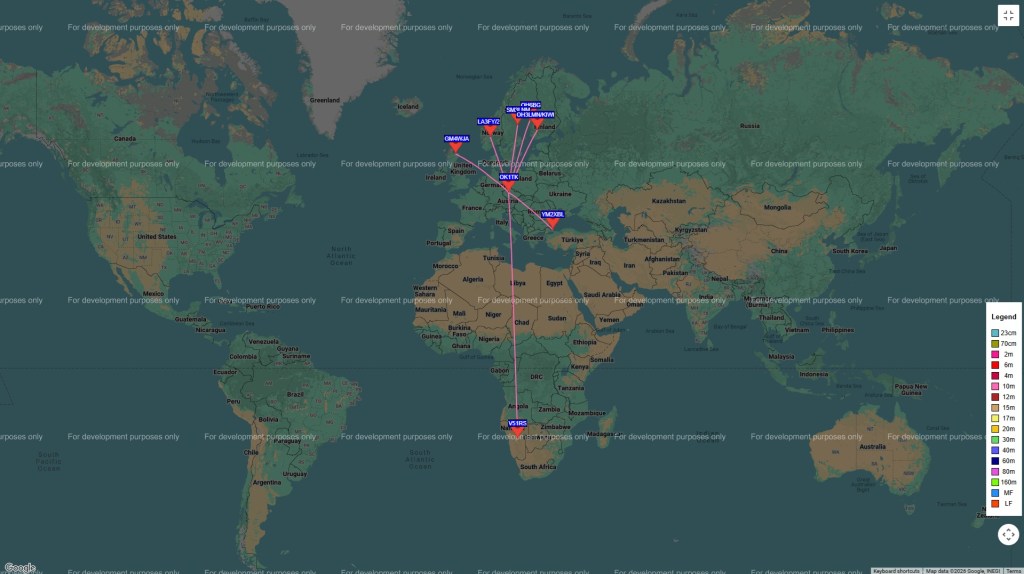
2026-07-25 WSPR ATAS-120A Testing 10m
Top 6 Longest-Distance Receptions
#
Callsign
Country
Grid Locator
SNR
Distance
1
V51RS
Namibia
JG87QL
−23 dB
8,076 km
2
OH6BG
Finland
KP03QA
−6 dB
1,500 km
3
GM4WJA
Scotland
IO87MN
−27 dB
1,409 km
4
OH3LMN/KIWI
Finland
KP11WM
−13 dB
1,400 km
5
SM3LNM
Sweden
JP82QG
−14 dB
1,369 km
6
LA3FY/2
Norway
JP40FJ
−28 dB
1,209 km
Top 5 Strongest Reception Reports
#
Callsign
Country
SNR
1
OH6BG
Finland
−6 dB
2
OH3LMN/KIWI
Finland
−13 dB
3
SM3LNM
Sweden
−14 dB
4
V51RS
Namibia
−23 dB
5
GM4WJA
Scotland
−27 dB
Summary
Transmit Power: 5 W Total WSPR Spots: 11 Longest DX: V51RS (Namibia) – 8,076 km Best Reception Report: −6 dB from OH6BG (Finland)
Coverage: The 10 m band was mostly closed during the test, with only 11 WSPR spots received. Despite the limited activity, one exceptional long-distance reception from Namibia reached 8,076 km, indicating a brief opening on the band.
12m (28 MHz)
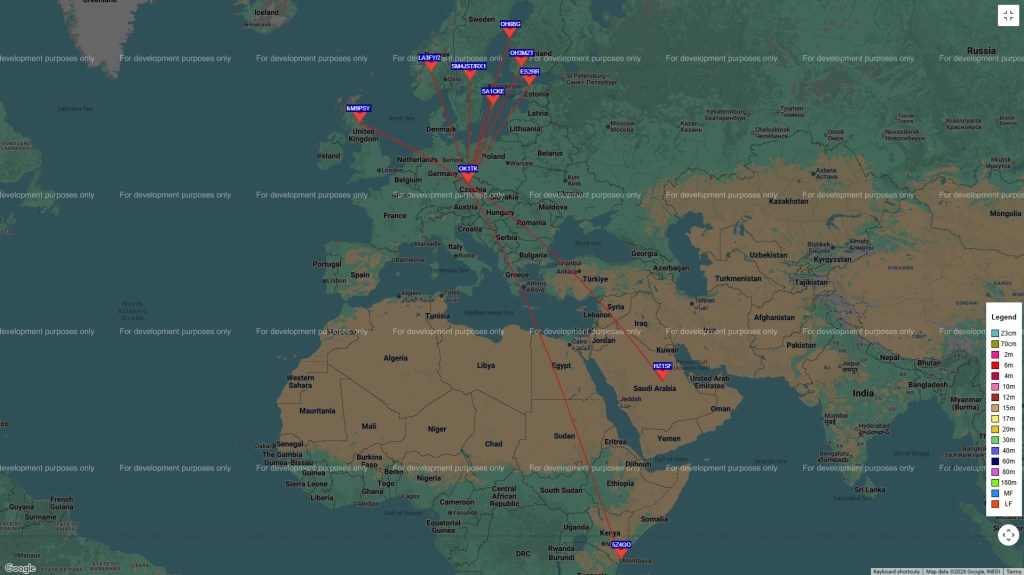
2026-07-25 WSPR ATAS-120A Testing 12m
Top 10 Longest-Distance Receptions
#
Callsign
Country
Grid Locator
SNR
Distance
1
5Z4GO
Kenya
KI96UA
−22 dB
6,479 km
2
HZ1SF
Saudi Arabia
LL34HQ
−24 dB
3,949 km
3
OH6BG
Finland
KP03QA
+2 dB
1,500 km
4
M9PSY
Northern Ireland
IO86HA
−17 dB
1,358 km
5
M9PSY-1
Northern Ireland
IO86HA
−17 dB
1,358 km
6
OH3MZT
Finland
KP10
−20 dB
1,275 km
7
ES2RR
Estonia
KO29HG
−18 dB
1,212 km
8
LA3FY/2
Norway
JP40FJ
−10 dB
1,209 km
9
SM4JST/RX1
Sweden
JO79KR
−16 dB
1,075 km
10
SA1CKE
Sweden
JO97HN
−20 dB
877 km
Top 5 Strongest Reception Reports
#
Callsign
Country
SNR
1
OH6BG
Finland
+2 dB
2
LA3FY/2
Norway
−10 dB
3
SM4JST/RX1
Sweden
−16 dB
4
M9PSY
Northern Ireland
−17 dB
5
M9PSY-1
Northern Ireland
−17 dB
Summary
Transmit Power: 5 W Total WSPR Spots: 19 Longest DX: 5Z4GO (Kenya) – 6,479 km Best Reception Report: +2 dB from OH6BG (Finland)
Coverage: Although the number of spots was relatively low, the 12 m band produced some impressive DX, including Kenya and Saudi Arabia. Most receptions came from northern and central Europe, with a brief opening towards East Africa and the Middle East.
15m (21 MHz)
2026-07-25 WSPR ATAS-120A Testing 15m
Top 10 Longest-Distance Receptions
#
Callsign
Country
Grid Locator
SNR
Distance
1
VK8TH
Australia
PH57NJ
−22 dB
12,970 km
2
K9CZI
USA
CN83MW
−17 dB
8,779 km
3
K9IMM
USA
EN52CV
−24 dB
7,343 km
4
K9TRV
USA
EN82BI
−21 dB
7,049 km
5
K9TRV-4
USA
EN82BI
−20 dB
7,049 km
6
K9TRV-5
USA
EN82BI
−21 dB
7,049 km
7
KD2OM
USA
FN12GX
−25 dB
6,620 km
8
WA2TP
USA
FN30LU
−27 dB
6,503 km
9
5Z4GO
Kenya
KI96UA
−22 dB
6,479 km
10
KQ2Y
USA
FN31GN
−25 dB
6,478 km
Top 5 Strongest Reception Reports
#
Callsign
Country
SNR
1
SK6WW
Sweden
+2 dB
2
OH6BG
Finland
0 dB
3
EA8/DF4UE
Canary Islands
−8 dB
4
SA6BSS/HL
Sweden
−8 dB
5
OH3LMN/KIWI
Finland
−9 dB
Summary
Transmit Power: 5 W Total WSPR Spots: 81 Longest DX: VK8TH (Australia) – 12,970 km Best Reception Report: +2 dB from SK6WW (Sweden)
Coverage: The 15 m band delivered excellent results, with 81 WSPR spots and outstanding long-distance propagation. Besides strong coverage across Europe, signals reached Australia, Kenya, and multiple stations across North America, with the longest reception coming from Australia at nearly 13,000 km.
17m (18 MHz)
2026-07-25 WSPR ATAS-120A Testing 17m
Top 10 Longest-Distance Receptions
#
Callsign
Country
Grid Locator
SNR
Distance
1
VK8TH
Australia
PH57NJ
−24 dB
12,970 km
2
K6VZK
USA
DM13NH
−22 dB
9,582 km
3
V51RS
Namibia
JG87QL
−24 dB
8,076 km
4
KD2OM
USA
FN12GX
−16 dB
6,620 km
5
WA2TP
USA
FN30LU
−23 dB
6,503 km
6
N2YCH
USA
FN31JG
−25 dB
6,483 km
7
KQ2Y
USA
FN31GN
−23 dB
6,478 km
8
VE3CWM
Canada
FN15XI
−28 dB
6,361 km
9
W1XP
USA
FN42FO
−23 dB
6,282 km
10
KM3T-3
USA
FN42ET
−25 dB
6,272 km
Top 5 Strongest Reception Reports
#
Callsign
Country
SNR
1
G8OCV/SDR
England
+1 dB
2
WESSEX
England
0 dB
3
SQ3H
Poland
0 dB
4
OH3MZT
Finland
−4 dB
5
OZ1BFM
Denmark
−5 dB
Summary
Transmit Power: 5 W Total WSPR Spots: 257 Longest DX: VK8TH (Australia) – 12,970 km Best Reception Report: +1 dB from G8OCV/SDR (England)
Coverage: The 17 m band delivered excellent propagation throughout the test, producing 257 WSPR spots. In addition to strong coverage across Europe, signals reached Australia, Namibia, Canada, and several stations across the United States, with the longest reception coming from Australia at 12,970 km.
20m (14 MHz)
2026-07-25 WSPR ATAS-120A Testing 20m
Top 10 Longest-Distance Receptions
#
Callsign
Country
Grid Locator
SNR
Distance
1
WA2TP
USA
FN30LU
−25 dB
6,503 km
2
HZ1SF
Saudi Arabia
LL34HQ
−21 dB
3,949 km
3
EA8BFK
Canary Islands
IL38BO
−23 dB
3,372 km
4
EA8/DF4UE
Canary Islands
IL38BP
−19 dB
3,368 km
5
4Z4TJ
Israel
KM71JF
−13 dB
2,689 km
6
CR7CDF
Portugal
IM58NM
−27 dB
2,242 km
7
TA4/G8SCU
Türkiye
KM56VO
−23 dB
2,041 km
8
EC1CS
Spain
IN62BI
−26 dB
1,910 km
9
SM2LTA
Sweden
JP94AT
−21 dB
1,653 km
10
TA3AWF
Türkiye
KM38IJ
−28 dB
1,619 km
Top 5 Strongest Reception Reports
#
Callsign
Country
SNR
1
ON5KQ
Belgium
+5 dB
2
EI4HQ
Ireland
+1 dB
3
G6MC/K
England
0 dB
4
G4ZFQ
England
−3 dB
5
WESSEX
England
−4 dB
Summary
Transmit Power: 5 W Total WSPR Spots: 438 Longest DX: WA2TP (USA) – 6,503 km Best Reception Report: +5 dB from ON5KQ (Belgium)
Coverage: The 20 m band delivered the highest activity of the entire test, producing 438 WSPR spots. Propagation was excellent across Europe, with numerous strong reception reports, while reliable DX paths reached North America, the Canary Islands, the Middle East, Portugal, Spain, and Türkiye. Although the maximum distance was shorter than on the higher HF bands, 20 m clearly provided the most stable and consistent propagation throughout the test, making it the best-performing band overall.
40m (7MHz)
2026-07-25 WSPR ATAS-120A Testing 40m
The 40 m band proved to be the most challenging during this test. The best result achieved was an SWR of approximately 2.5, using the original WiMo elevated radials, the ground stake system described earlier, and four additional 15 m wire radials (0.75 mm² PVC-insulated wire) connected at the antenna feed point approximately 2 m above ground. Removing the WiMo radials increased the minimum SWR to about 3.0, while shortening the wire radials by folding them back only made the match worse. Further experimentation with the radial system will therefore be required.
Top 10 Longest-Distance Receptions
#
Callsign
Country
Grid Locator
SNR
Distance
1
EI4HQ
Ireland
IO51UU
−30 dB
1,599 km
2
OH6BG
Finland
KP03QA
−6 dB
1,500 km
3
OH6AH
Finland
KP12KR
−7 dB
1,498 km
4
OH3LMN/KIWI
Finland
KP11WM
−9 dB
1,400 km
5
M9PSY
Northern Ireland
IO86HA
−24 dB
1,358 km
6
M9PSY-1
Northern Ireland
IO86HA
−24 dB
1,358 km
7
M9PSY-2
Northern Ireland
IO86HA
−25 dB
1,358 km
8
F4FPR
France
IN88DI
−24 dB
1,330 km
9
ES4O
Estonia
KO39DC
−18 dB
1,258 km
10
WESSEX
England
IO80QR
−7 dB
1,211 km
Top 5 Strongest Reception Reports
#
Callsign
Country
SNR
1
OE3GBB
Austria
+15 dB
2
LX1LC
Luxembourg
+9 dB
3
DC5AL-R
Germany
+7 dB
4
DL4ZBE
Germany
+7 dB
5
OZ7IT
Denmark
+5 dB
Summary
Transmit Power: 5 W Total WSPR Spots: 282 Longest DX: EI4HQ (Ireland) – 1,599 km Best Reception Report: +15 dB from OE3GBB (Austria)
Coverage: Despite the relatively poor antenna match on 40 m, the antenna still generated 282 WSPR spots across much of central, northern and western Europe. No intercontinental propagation was observed on this band during the test, but regional coverage was excellent, demonstrating that the ATAS-120A remains usable on 40 m even with an SWR of around 2.5. Further optimisation of the elevated radial system should improve both the impedance match and overall performance.
Overall WSPR Coverage
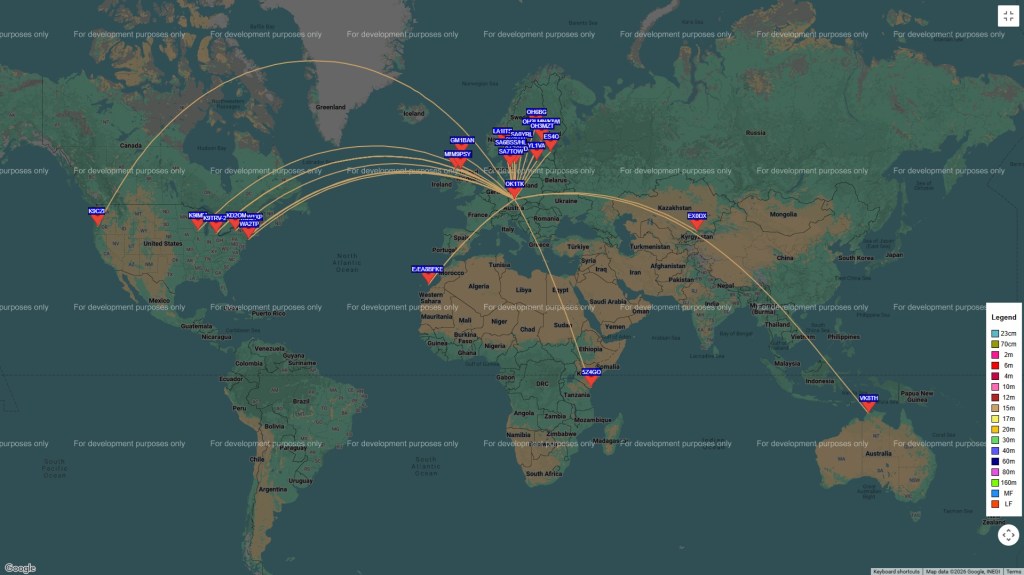
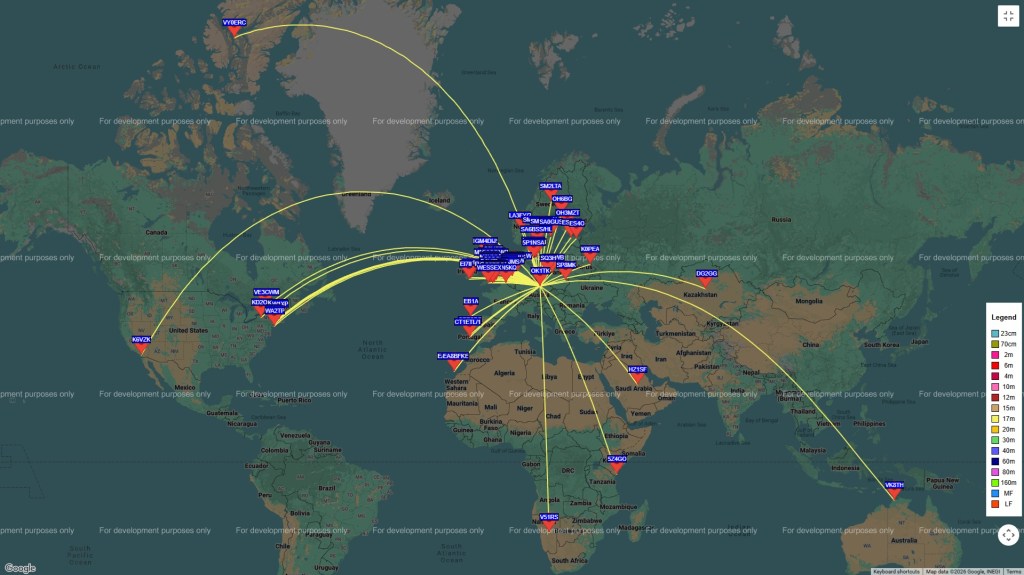
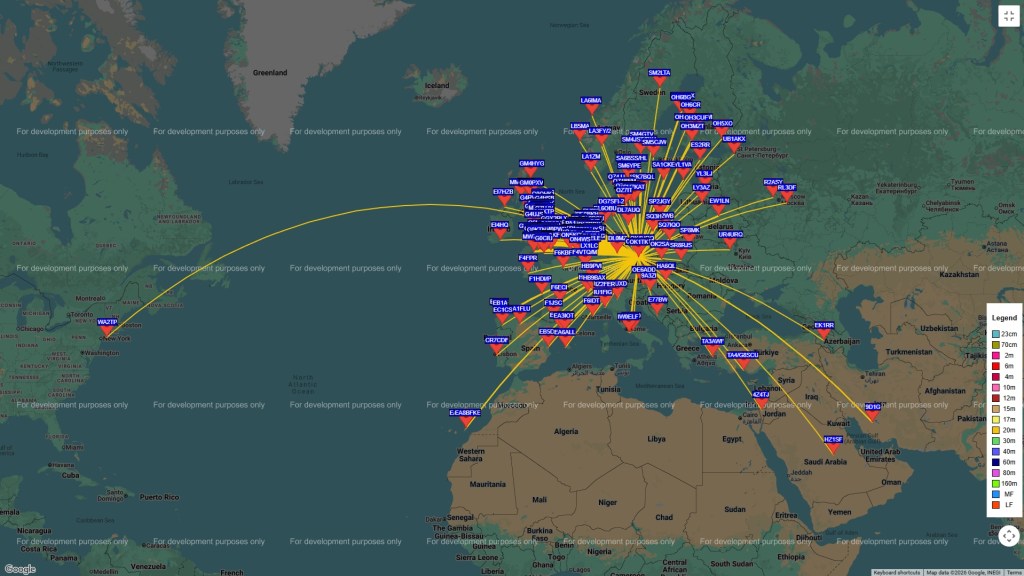
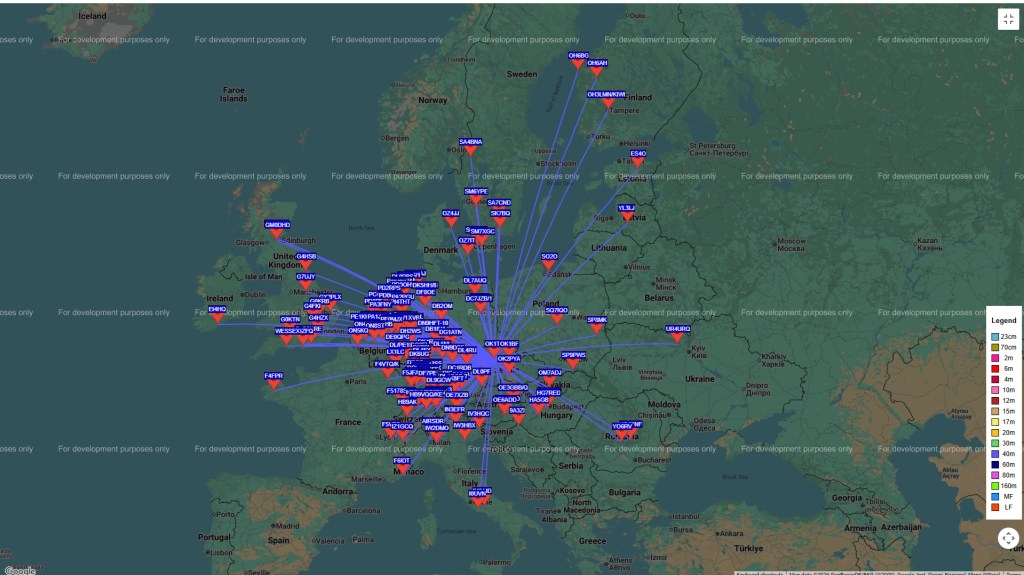
The map below shows the overall reception coverage achieved during the test. The vast majority of reception reports shown were obtained during the 5 W WSPR measurements described in this article. Some additional markers may originate from separate 10 W FT8 activity performed during the same period.
2026-07-25 PSK Reporter ATAS-120A Testing All Band
Even so, the map clearly demonstrates the excellent coverage achieved with the portable ATAS-120A setup, reaching stations throughout Europe, North America, Africa, the Middle East, Asia, and Australia.
After making several improvements to the antenna’s counterpoise system and portable setup, I finally had the opportunity to evaluate the Yaesu ATAS-120A under real-world WSPR operating conditions.
The primary goal of this outing was to compare the antenna’s performance on the 10 m, 12 m, 15 m, and 17 m amateur bands. I also planned to continue with 20 m and, finally, perform a series of experiments on 40 m using a newly designed counterpoise system specifically developed for that band.
2026-07-19 WSPR ATAS-120A Testing
Test Conditions
The test was carried out from grid locator JO70FB (Prague, Czech Republic).
Unfortunately, the weather was far from ideal. Heavy rain showers and thunderstorms moved through the area during the test, forcing me to keep the operating session much shorter than originally planned.
Despite these conditions, I was still able to collect enough data to evaluate the higher HF bands.
Results
Considering both the weather and the limited operating time, I was pleasantly surprised by the overall performance of the antenna.
The 10 m, 12 m, 15 m, and 17 m bands all produced very encouraging results. WSPR spots were received from stations across Europe, along with several long-distance DX receptions, confirming that the ATAS-120A performs remarkably well in a portable configuration.
The detailed results for each band, including the Top 10 DX receptions, are presented in the following sections.
10 m (28 MHz)
2026-07-19 WSPR ATAS-120A Testing 10m
Top 10 Longest-Distance Receptions
#
Callsign
Country
Grid Locator
SNR
Distance
1
EA8/DF4UE
Canary Islands
IL38BP
−21 dB
3,368 km
2
4X1DA
Israel
KM71LV
−23 dB
2,641 km
3
RX6ART
Russia
KN95RL
−14 dB
1,926 km
4
EA1FAQ
Spain
IN71PN
−18 dB
1,753 km
5
EA5XQ
Spain
IM99
−20 dB
1,691 km
6
SM2KOT
Sweden
JP95HB
−16 dB
1,685 km
7
SWLIO53PS
England
IO53PS
−21 dB
1,633 km
8
SV1BTL
Greece
KM18VA
−17 dB
1,530 km
9
OH6BG
Finland
KP03QA
−13 dB
1,500 km
10
GM4WJA
Scotland
IO87MN
−2 dB
1,409 km
Top 5 Strongest Reception Reports
#
Callsign
Country
SNR
1
ON5KQ
Belgium
+20 dB
2
ON5HB
Belgium
+11 dB
3
LX1LC
Luxembourg
+10 dB
4
G8OCV/SDR
England
+10 dB
5
PE0MJX
Netherlands
+9 dB
Summary
Total Number of WSPR Spots: 162 Transmit Power: 5 W Longest DX:EA8/DF4UE (Canary Islands) – 3,368 km Best Reception Report:+20 dB from ON5KQ (Belgium)
12 m (24 MHz)
2026-07-19 WSPR ATAS-120A Testing 12m
Top 10 Longest-Distance Receptions
#
Callsign
Country
Grid Locator
SNR
Distance
1
EA8/DF4UE
Canary Islands
IL38BP
−25 dB
3,368 km
2
EA1FAQ
Spain
IN71PN
−23 dB
1,753 km
3
EI4HQ
Ireland
IO51UU
−18 dB
1,599 km
4
SV1BTL
Greece
KM18VA
−15 dB
1,530 km
5
OH6BG
Finland
KP03QA
+1 dB
1,500 km
6
M9PSY
Northern Ireland
IO86HA
−18 dB
1,358 km
7
M9PSY-1
Northern Ireland
IO86HA
−23 dB
1,358 km
8
M9PSY-2
Northern Ireland
IO86HA
−17 dB
1,358 km
9
EA3IQK
Spain
JN11BJ
−12 dB
1,355 km
10
GM4DTH
Scotland
IO85JW
−17 dB
1,345 km
Top 5 Strongest Reception Reports
#
Callsign
Country
SNR
1
HB9VQQ
Switzerland
+18 dB
2
HB9VQQ/RS
Switzerland
+18 dB
3
DARCT13
Germany
+17 dB
4
HB9VQQ/RE
Switzerland
+17 dB
5
HB9VQQ/RL
Switzerland
+13 dB
Summary
Transmit Power: 5 W Total WSPR Spots: 118 Longest DX: EA8/DF4UE (Canary Islands) – 3,368 km Best Reception Report: +18 dB from HB9VQQ (Switzerland) Coverage: Excellent propagation across Europe, with the longest reception reaching the Canary Islands.
15 m (21 MHz)
2026-07-19 WSPR ATAS-120A Testing 15m
Top 10 Longest-Distance Receptions
#
Callsign
Country
Grid Locator
SNR
Distance
1
V51RS
Namibia
JG87QL
−28 dB
8,076 km
2
VE6JY
Canada
DO33OR
−22 dB
7,467 km
3
WD4ELG
USA
FM06BE
−21 dB
7,291 km
4
WA2TP
USA
FN30LU
−23 dB
6,503 km
5
KQ2Y
USA
FN31GN
−22 dB
6,478 km
6
EA8BFK
Canary Islands
IL38BO
−24 dB
3,372 km
7
EA8/DF4UE
Canary Islands
IL38BP
−20 dB
3,368 km
8
EA1FAQ
Spain
IN71PN
−14 dB
1,753 km
9
EA5XQ
Spain
IM99
−22 dB
1,691 km
10
SM2LTA
Sweden
JP94AT
−21 dB
1,653 km
Top 5 Strongest Reception Reports
#
Callsign
Country
SNR
1
HB9VQQ
Switzerland
+27 dB
2
HB9GZW
Switzerland
+17 dB
3
DK6UG
Germany
+17 dB
4
IW3HBX
Italy
+8 dB
5
DARCT13
Germany
+6 dB
Summary
Transmit Power: 5 W Total WSPR Spots: 281 Longest DX: V51RS (Namibia) – 8,076 km Best Reception Report:+27 dB from HB9VQQ (Switzerland) Coverage: Outstanding propagation across Europe, North America, the Canary Islands, and Africa, with the longest reception reaching Namibia.
17 m (18 MHz)
2026-07-19 WSPR ATAS-120A Testing 17m
Top 10 Longest-Distance Receptions
#
Callsign
Country
Grid Locator
SNR
Distance
1
V51RS
Namibia
JG87QL
−23 dB
8,076 km
2
VE6JY
Canada
DO33OR
−21 dB
7,467 km
3
N4MXZ
USA
FM17FK
−29 dB
7,046 km
4
KD2OM
USA
FN12GX
−25 dB
6,620 km
5
WA2TP
USA
FN30LU
−24 dB
6,503 km
6
KQ2Y
USA
FN31GN
−22 dB
6,478 km
7
VY0ERC
Canada (Nunavut)
ER60TB
−19 dB
4,753 km
8
HZ1SF
Saudi Arabia
LL34HQ
−28 dB
3,949 km
9
7Z1DH
Saudi Arabia
LL24FN
−17 dB
3,834 km
10
EA8/DF4UE
Canary Islands
IL38BP
−23 dB
3,368 km
Top 5 Strongest Reception Reports (Unique Stations)
#
Callsign
Country
SNR
1
PA0LSB
Netherlands
+17 dB
2
DD5XX
Germany
+15 dB
3
IW3HBX
Italy
+15 dB
4
ON5KQ
Belgium
+15 dB
5
DK6UG
Germany
+12 dB
Summary
Transmit Power: 5 W Total WSPR Spots: 457 Longest DX: V51RS (Namibia) – 8,076 km Best Reception Report:+17 dB from PA0LSB (Netherlands) Coverage: Excellent propagation extending across Europe, North America, the Middle East, the Canary Islands, and Africa, with the longest reception reaching Namibia.
An Unexpected Technical Issue
When I switched to 20 meters, an unexpected problem prevented me from continuing the test.
During transmission, both JTDX and WSJT-X repeatedly reported an „Unable to read audio input“ error, causing the software to stop decoding. Restarting the applications—and even the computer—temporarily solved the issue, but it returned after some time.
At the moment, I suspect that RF energy is coupling into the DigiRig Mobile USB interface, particularly on the lower HF bands.
For my next field test, I plan to:
replace the current USB cable with a higher-quality shielded cable,
install ferrite common-mode chokes on the USB cable,
add additional ferrites to the remaining interconnecting cables if necessary.
Only after solving this issue will I be able to complete the planned testing on the 20-meter band.
40-Meter Counterpoise Experiments
Because the weather deteriorated rapidly, I unfortunately had to cancel the part of the test I had been looking forward to the most—the 40-meter counterpoise experiments.
For this band, I have designed a new counterpoise configuration using longer radials specifically optimized for 40 meters. Based on earlier measurements, I expect this setup to provide a noticeable improvement compared to my previous portable configuration.
These experiments will therefore have to wait until my next portable outing.
Conclusion
Despite the poor weather and the unexpected technical issues, I consider this field test a success.
The results clearly demonstrate that the Yaesu ATAS-120A, when combined with a properly designed counterpoise system, is capable of delivering excellent performance in portable WSPR operation.
Over the coming days, I will continue updating this article with detailed results for each band, including Top 10 DX stations, propagation maps, and additional observations from future field tests.
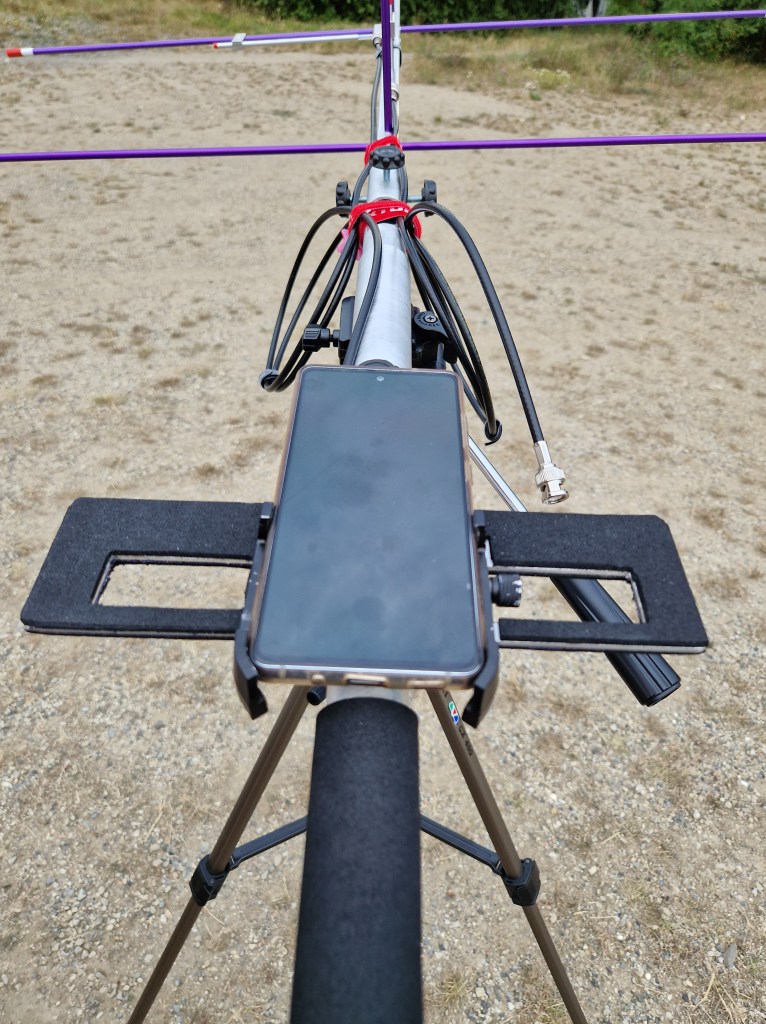
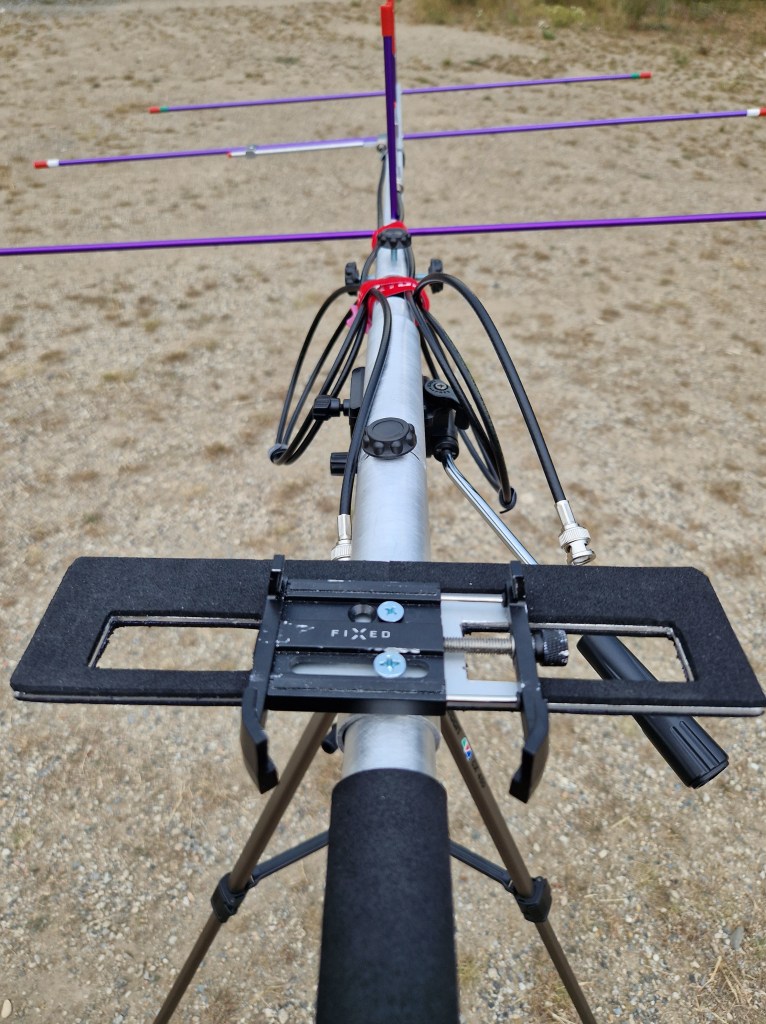
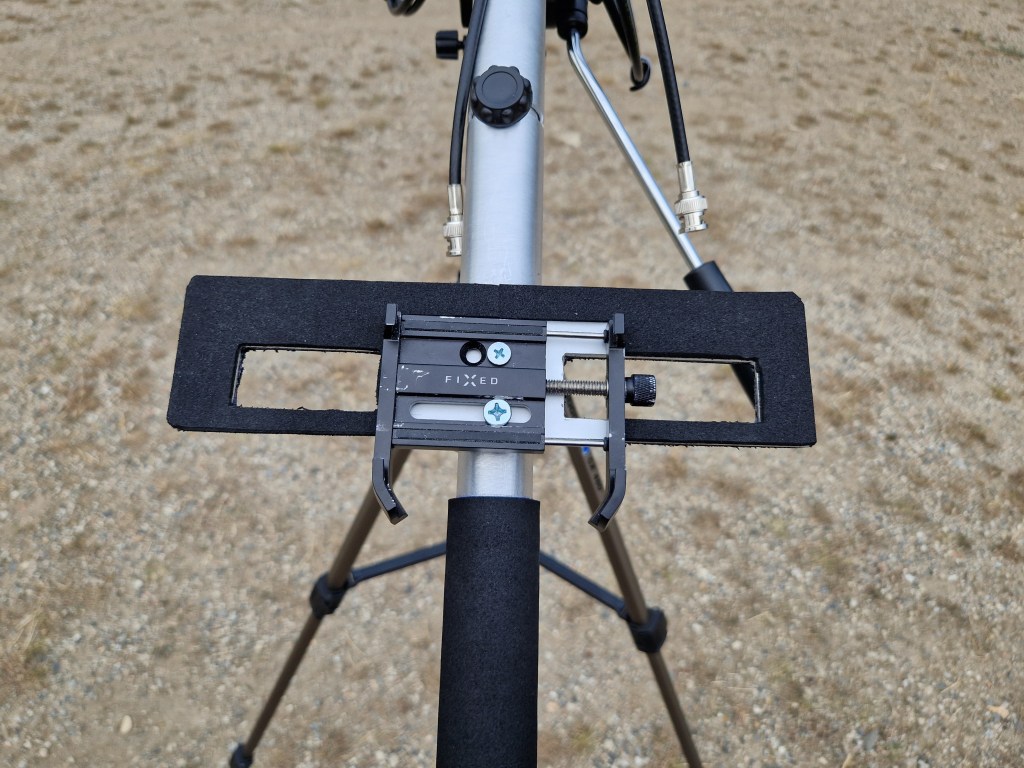
As part of my portable station, I wanted to use a Yaesu ATAS-120A antenna on a K&F Concept K234A7 tripod. This led me to design a custom mount that could accommodate both the antenna and the WiMo Counterpoise Kit.
The full article includes technical drawings, assembly photographs and details of two different mounting configurations.
On Sunday July 28th at about 10:55 UTC a made my first three QSOs via satellite. It was the Saudi-OSCAR 50 (SO-50) satellite. Unfortunately no camera was at this time. Later the same day I tried another attempt via the same satellite and I made two QSOs with Ukrainian HAM radio stations.
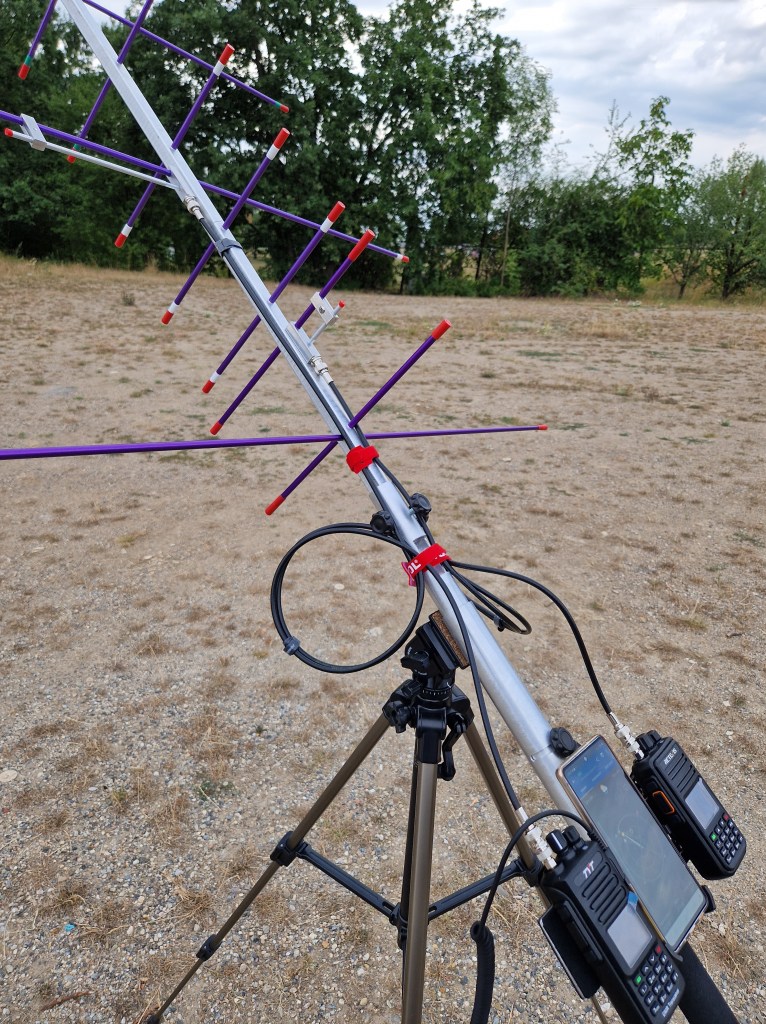
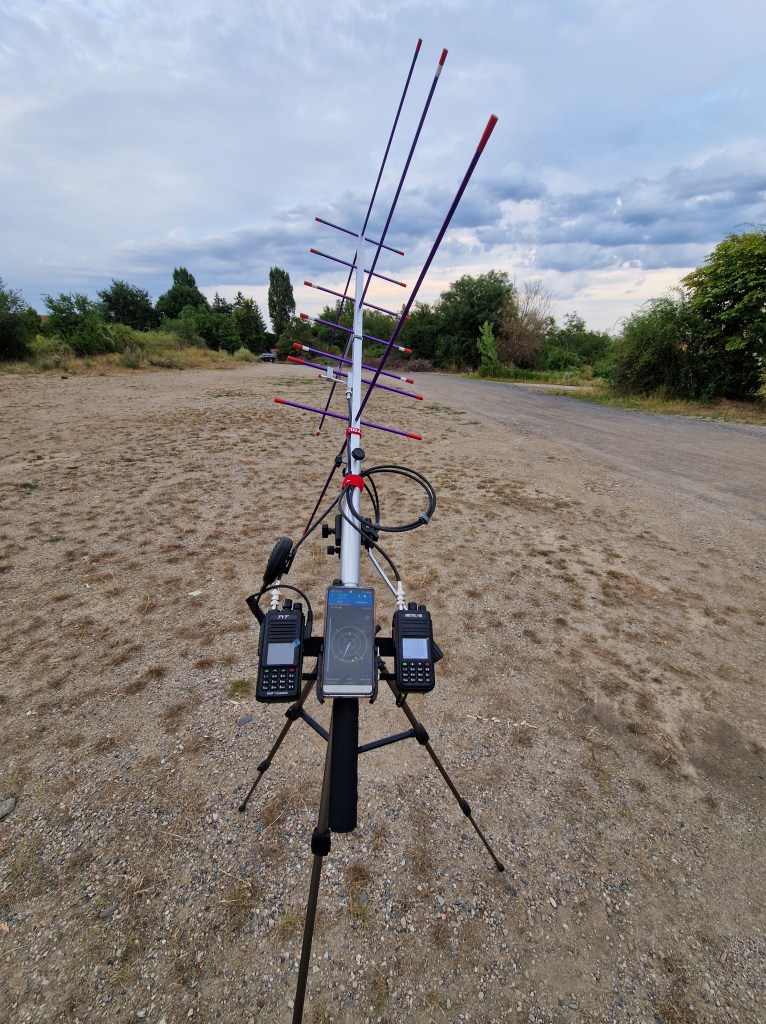
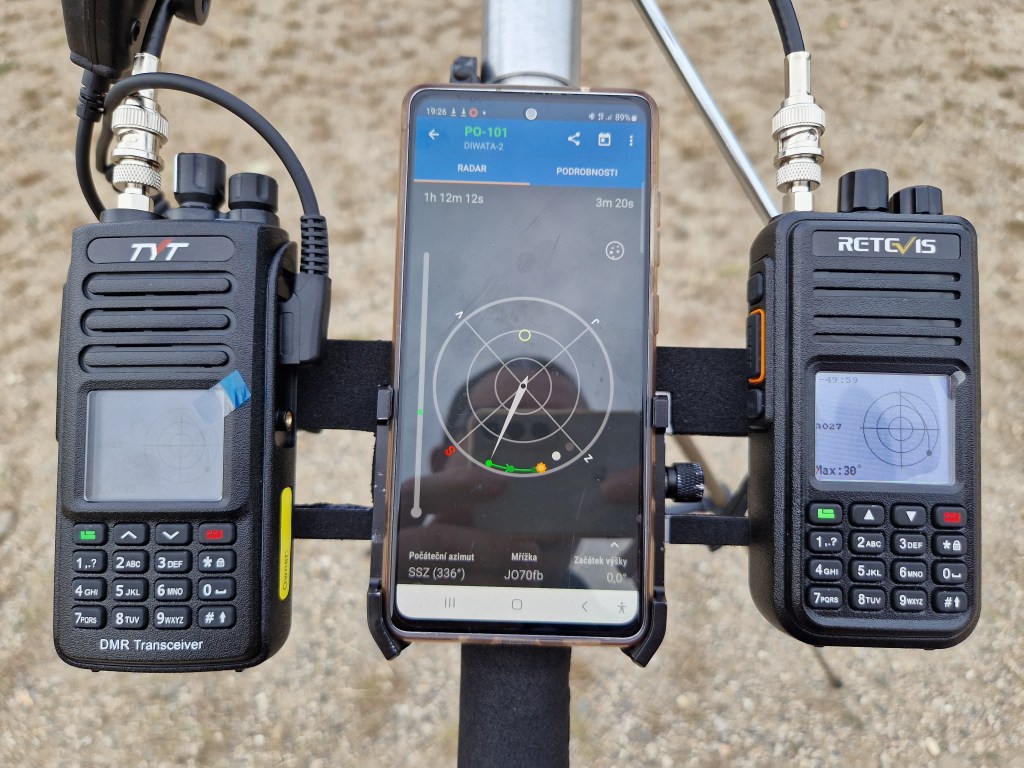
Testing our new ARROW II Satellite antenna setup with home made antenna holder mounted on a Velbon tripod. We used two OpenGD77 radios, Retevis RT3S for Rx and TYT MD-UV390 Plus 10W for Tx. With the possibility to adjust the polarisation the reception was much more better. Unfortunately there was a short inexplicable reception loss and then issues while Tx. So, more experience needed….
Our first test of the ARROW II portable Yagi antenna for Satellite 146/437MHz with the Radioddity GD-88 TRX. Listening to the SO-50 satellite in the JO80ac locator.
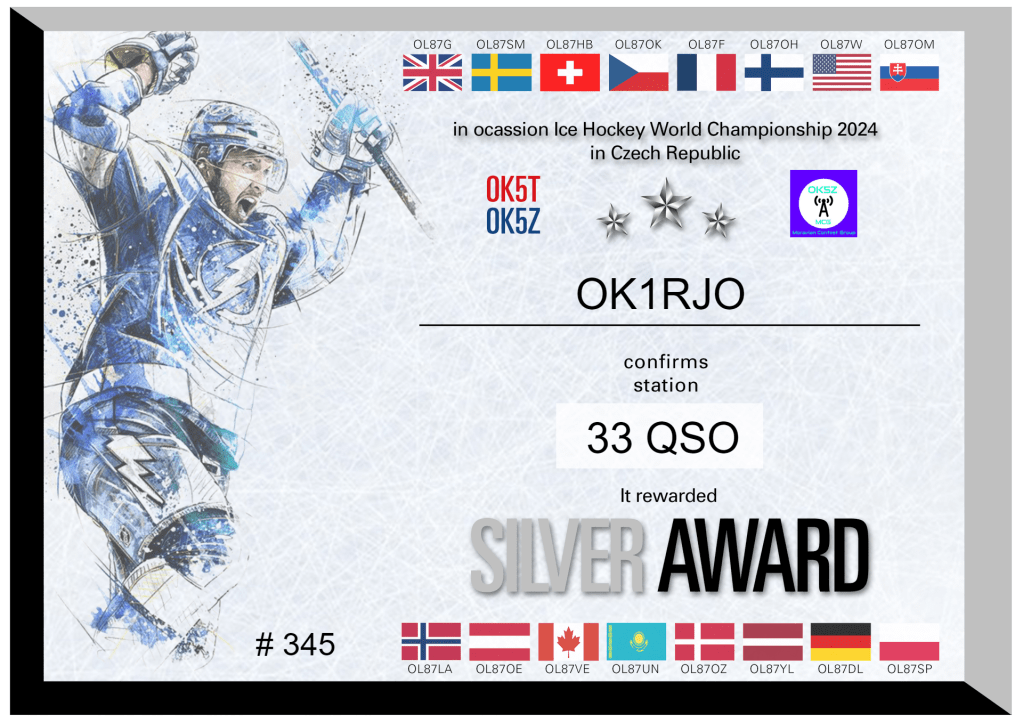
During the 87th Men’s World Ice Hockey Championship, station OK1TK and club station OK1RJO participated in a diploma contest for contacts made with occasional stations OL87DL, OL87F, OL87G, OL87HB, OL87LA, OL87OH, OL87OK, OL87SPOM, OL87OL8OL8OL , OL87W, OL87YL and received the following diplomas:
Diplomas obtained by stations mi OK1RJO and OK1TK during the month of April 2024 as part of the competition of 75th ANNIVERSARY Unión de Radioaficionados Españoles.